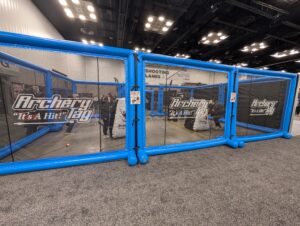
Rushmore Rumble Signage
The Rushmore Rumble is one of the newer, maybe the newest, NFAA indoor shoots. For its first few years, it was actually held near Mt. Rushmore, but the prospect of driving across South Dakota in early January was not appealing to me. This year, it moved to Indianapolis, Indiana. Worse for the name association, better for the attendance. It was also operated adjacent, both in time and space, to the Archery Trade Association and Archery & Bowhunting Supershow.
So, I departed Grand Rapids on Friday, mid-morning to get into Indianapolis about 3:30PM, checked in to the hotel, carted the bow etc. over to the Indianapolis Convention Center for the shoot. Did about 90 arrows practice Friday night. This was possibly a mistake. I had practiced on Thursday evening and Rushmore is a two day shoot – having that be days three and four in a row of shooting is tough.
I was quite hungry, having eaten not much but bars to that point, and went out for dinner & a beer. Probably would have felt better if I had had something lighter and no beer.
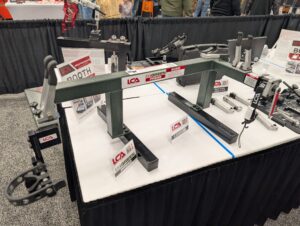
Saturday, the Archery Supershow opened at 9, so I headed over to wander that for the AM until my line time at 3:30. Saw some cool new stuff that I didn’t know about and got to check out a couple things that I knew of but wanted to see in person. Note that I am also very willing to walk by a lot of booths that don’t interest me – anything that doesn’t show some demonstrable engineering improvement over the previous version really doesn’t grab my interest. There were hundreds of booths at the show, I probably had a real interest in maybe 20 of them. Technically, it was also the bowhunting show, and while I do bowhunt, I mostly don’t care about hunting stuff. Better branded camo? Broadheads that can go through a truck hood? Bait that I cannot use? Hunting trips that cost more than my yearly archery budget? That one guy who claims to just *know* how deer think? Skip.
Stand out items that caught my interest, in no specific order:
Revolution Bow
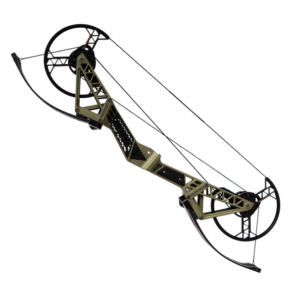
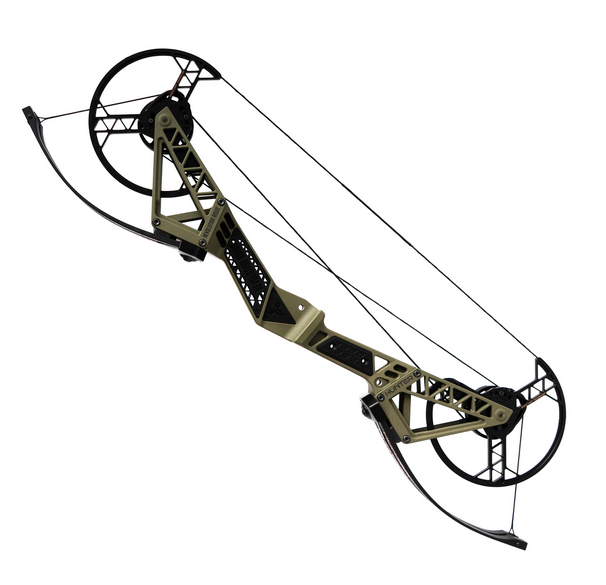
Revolution Archery’s “first” static cam hunting bow.
I have to imagine this was the most talked about thing of the entire show. I quote the first because, as the internet was quick to point out, the concept has been done before, long ago as one of the very first compound bows. The idea is that the cams are rigidly mounted to the frame and the limbs are drawn in toward the frame rather than toward each other or toward the archer. There’s some logic to this arrangement since the cams can be more solidly mounted and don’t add weight to the limb tips that has to move when shot. The down side to this particular implementation seemed to be that the riser design and machining was very clunky – lots of square edges that had a basic filet on them and not much more. When you look at the intricacy of machining that goes into modern compound bows, it’s kind of crazy and they’re just not there.
The other thing is that the cam was huge. This isn’t inherently bad, but I have to assume it was more about design than function. The diameter of the string track vs the cable track sets the mechanical advantage of the string to the limbs, so it seems that this bow must have some super stiff limbs to have that big of string track and that small of cable track. It also needs huge cams to get to standard draw lengths around 30 inches, given the relatively short 24″ axle-to-axle measurement. It’s sold as a hunting bow and compactness is important to a lot of people in that market. Still, I think it would be better to make the riser 6-8″ longer and make the cams 3-4″ smaller diameter – the overall package wouldn’t be any larger and it would be that much more stable. Put a bit more into the design and machining and the weight probably wouldn’t even need to increase.
OK, so why is it an interesting concept?
First, those cams are on axles mounted rigidly to the riser – this should eliminate any cam lean and allow the string to track directly down the center of the bow. This is a challenge which all manufacturers must overcome one way or another.
Second, the limbs don’t need to be at the end of the bow. If those limbs don’t have an axle (which they might, but it wouldn’t be strictly necessary) they could be on either side of the cam and/or the string. They could be mounted the other way so they flexed outward when the bow was drawn. If you wanted to make this more compact, that would be an option.
Third, if you turn it on it’s side, it’s highly reminiscent of a Tron Lightcycle.
Speed Broadhead
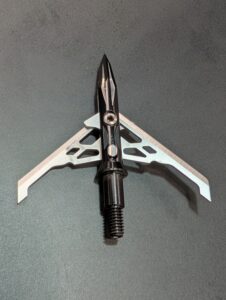
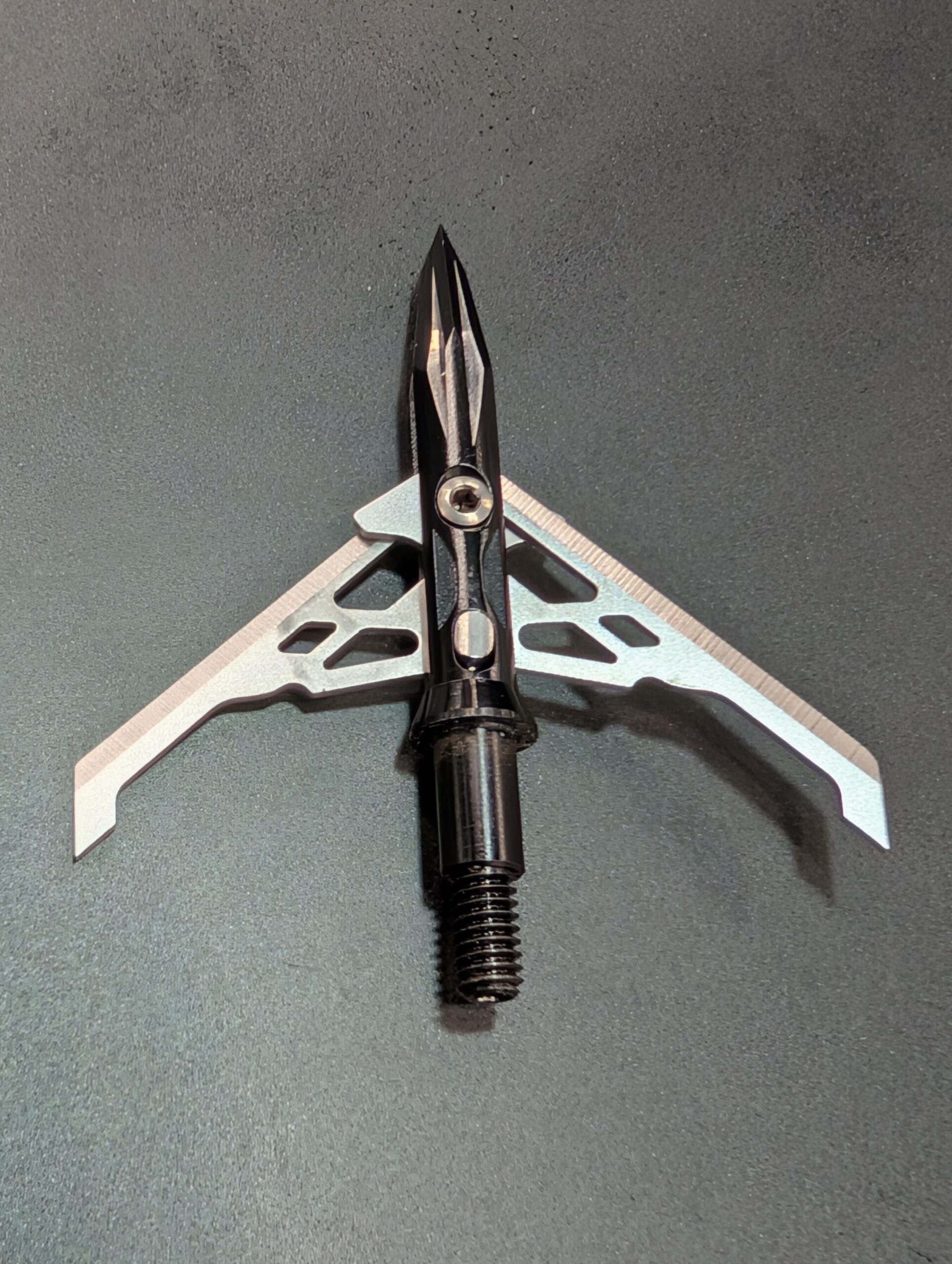
Speed Broadheads
Made by the same guy why invented the Rage broadhead, a mechanical broadhead on which the blades “slide” back rather than pivot from the front. Rage was sold to a conglomerate years ago and the quality has gone down ever since and they’ve been heavily knocked off, so it’s not surprising that there was room to improve here.
But, this isn’t just a new version of the same thing. The really cool part is that the mechanism that holds them shut is entirely internal, good for blade retention at all speeds and is spring and bearing based so it’s not a sacrificial component like a plastic retainer or rubber band. Secondly, they are aluminum (for weight) but are a higher grade of aluminum than most anything else (not just broadheads) made today and thus should be strong enough to take some abuse.
Lastly, unlike modern Rage broadheads, I was assured that they come out of the package sharp.
Down side – that intricate machining and state of the art materials mean they’re quite pricey.
Carbon Express Target Arrows
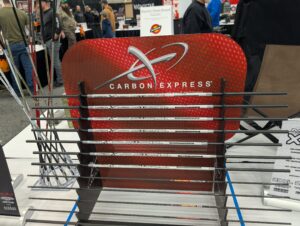
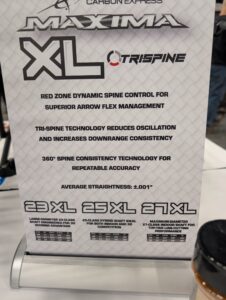
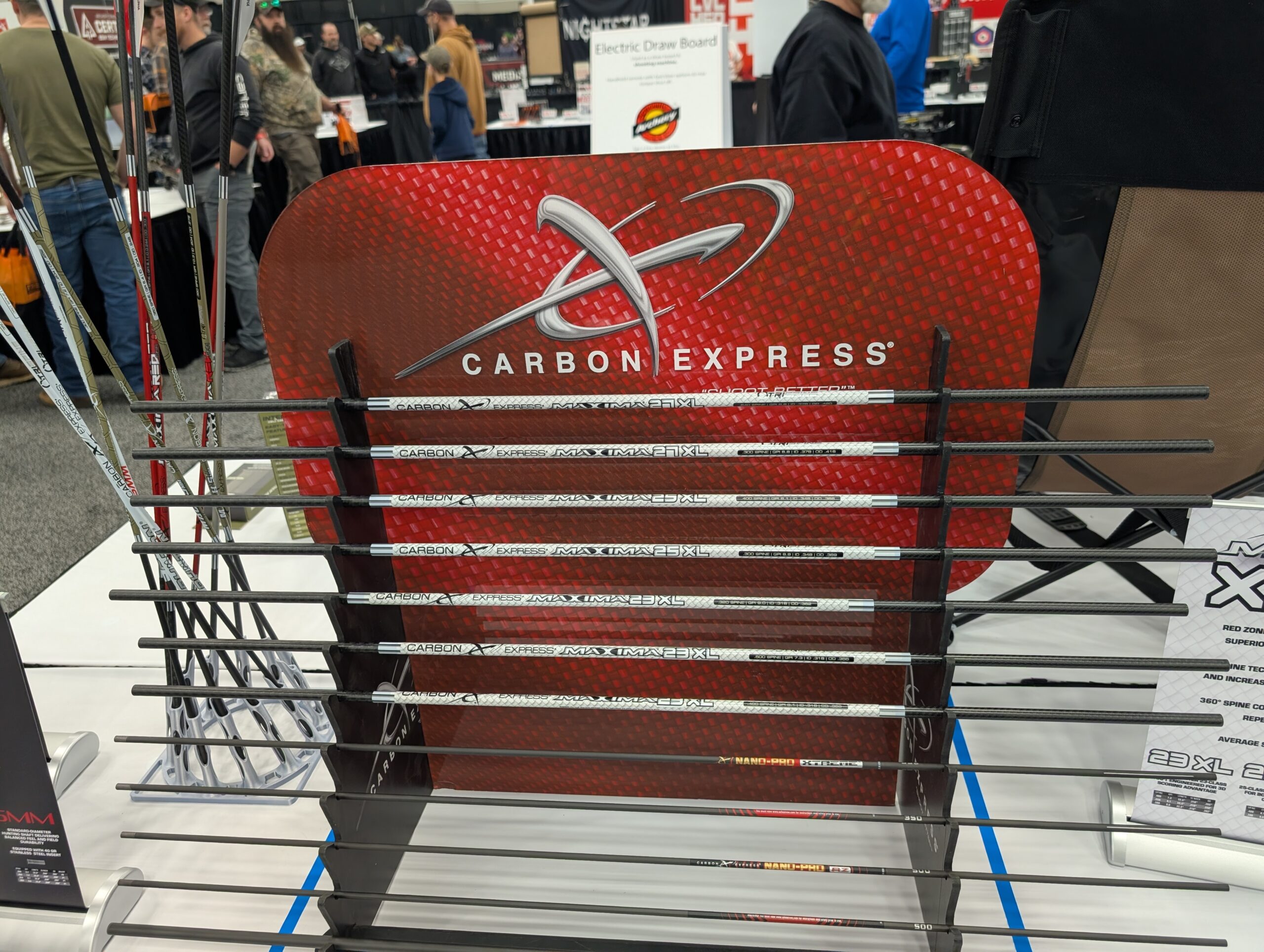
Carbon Express Maxima XL
Apparently Carbon Express is going to start making target arrows again. This is interesting, because Carbon Express used to be some of the most highly regarded arrows you could get and, they were also bought by a conglomerate who stripped the company for parts and discontinued much of their lineup. They’re still owned by FeraDyne, but maybe they’ve decided to actually bring new product to the market again.
A .300 spine 27/64ths diameter arrow is pretty rare. It comes with a high risk of being quite fragile – I had some .350 spine 27’s before and one of them broke clean off in a foam bale. Incidents of shattered carbon arrows are one of the most disturbing forms of archery gore on the internet, so I was a bit scared and never touched that brand again. I’ll be curious to see how these fair in the real world.
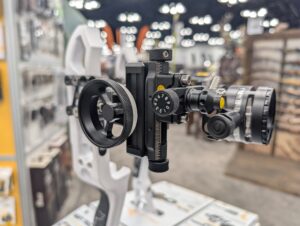
Trophy Ridge Swift Sight
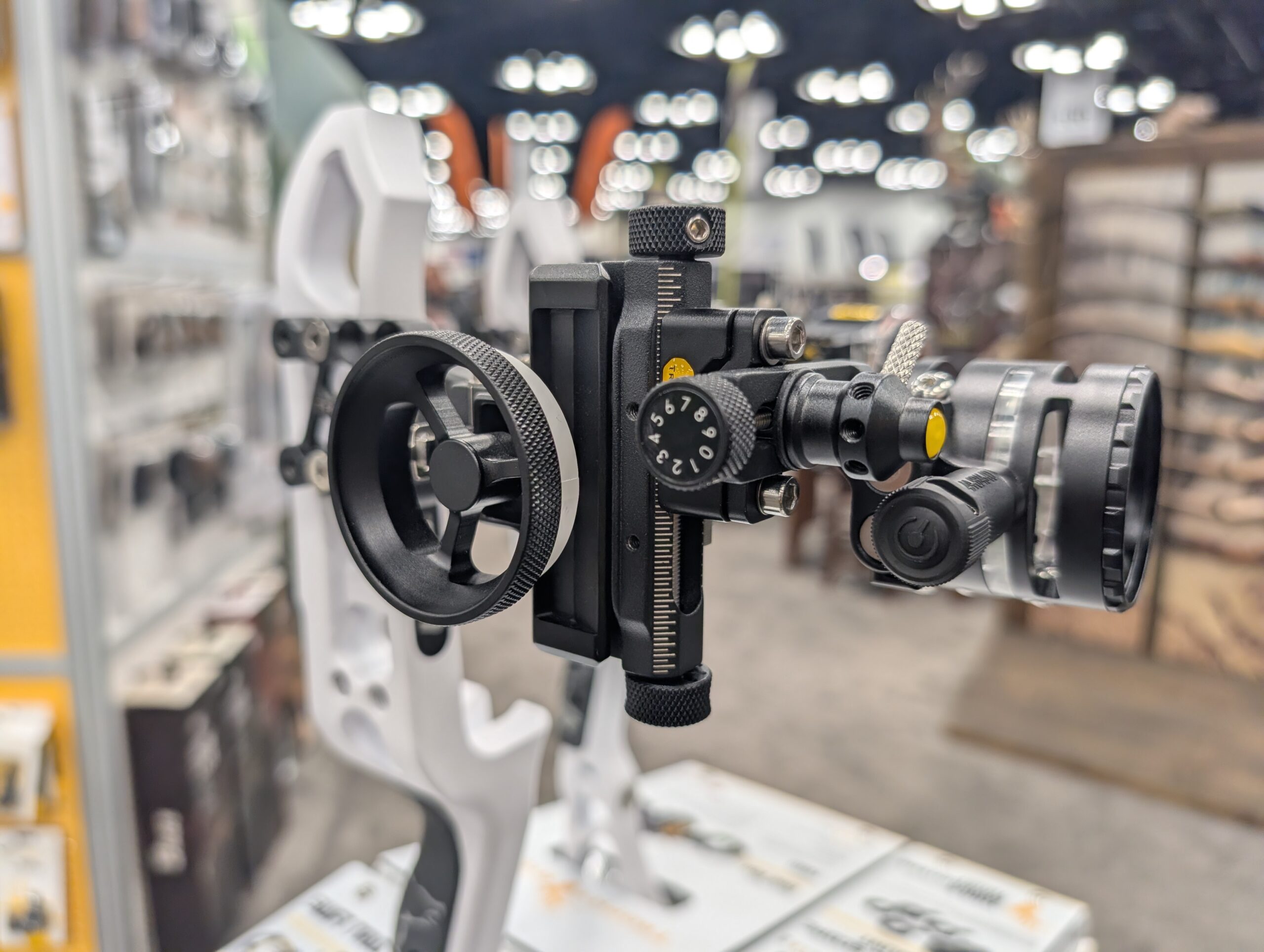
Trophy Ridge Swift Sight
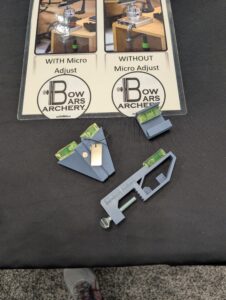
This seems like a nice enough product, though I’m not sure it offers anything truly new. I found it curious more than anything – that’s a redundant elevation micro-adjust screw and elevation dial. I don’t think my question of “What is the point?” resonated.
Both the dial and a micro-adjust for vertical travel cover the same 2-3 inch range. The intent is that the micro adjust gets used at 20 yards and then you use the dial and a sight tape for all other distances and kind of never touch the micro adjust again. 1) That’s 2-3x the micro adjust range needed. 2) These sights work off a range tape, which has an indicator needle. 3) That indicator needle is what needs to be adjustable.
This puts the scope mounted on two entirely independent and redundant rails which is double points of movement, tolerance stackup and possibly failure. And it costs more to make!
Axcel Perfect Mount V-Bar
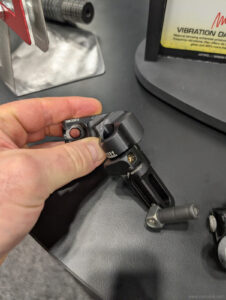
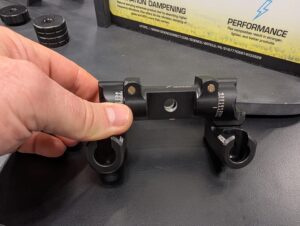
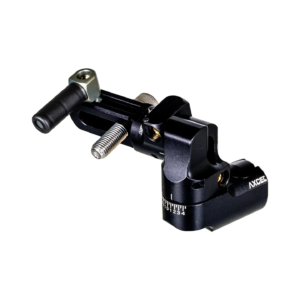
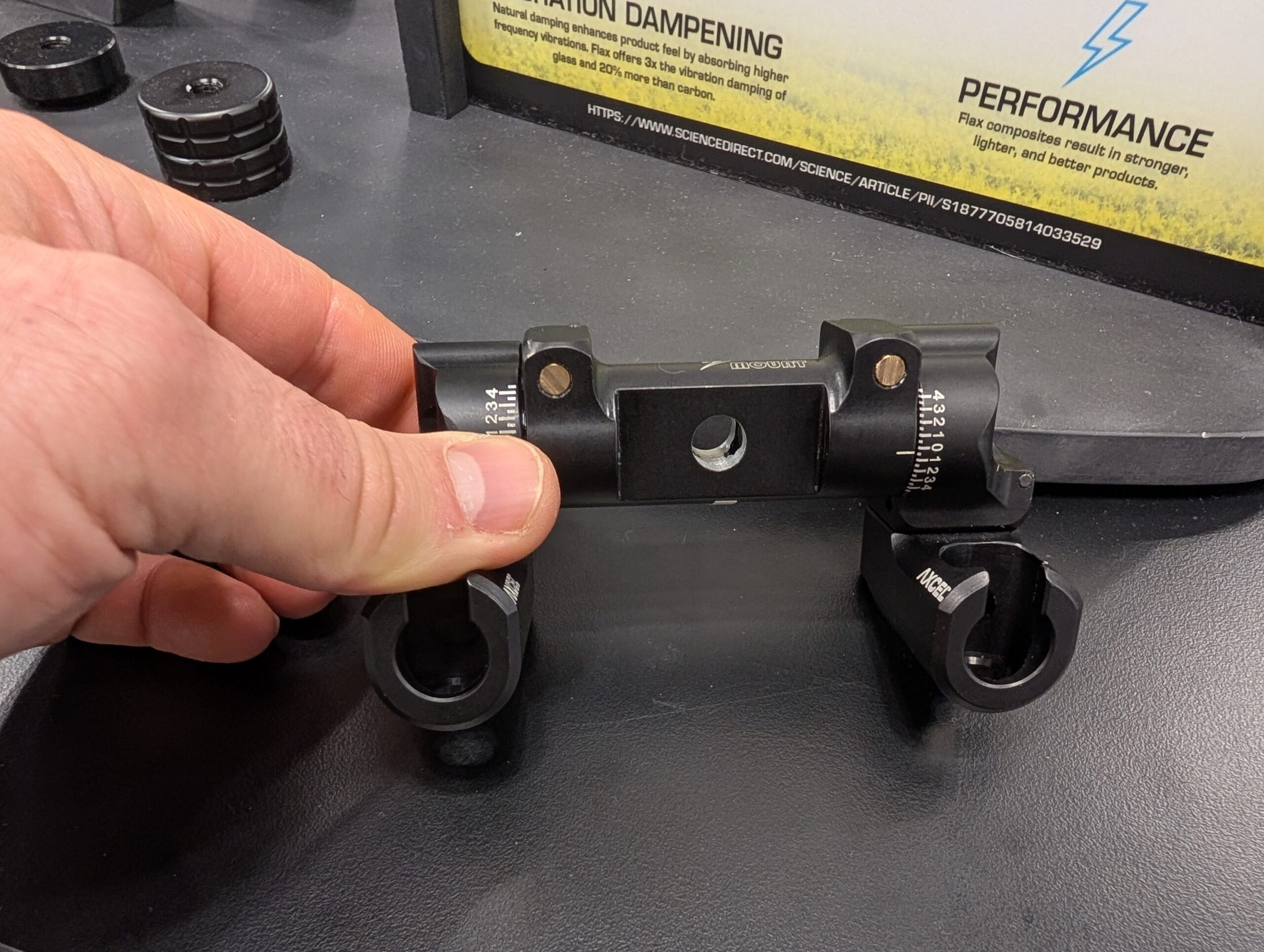
Axcel Perfect Mount V-Bar and Offset Mount
This is a bar mount that has a worm gear for adjusting and holding in place. They also have a bracing pin (not new with this product, but new with the Trilock which was the predecessor) to keep the mount from rotating even if the bolt does come loose. All this *should* be overkill, but as someone who runs pounds of weight off his rear bar, trying to crank down on a 5/16″ bolt hard enough to hold that in place is no fun, so I appreciate it.
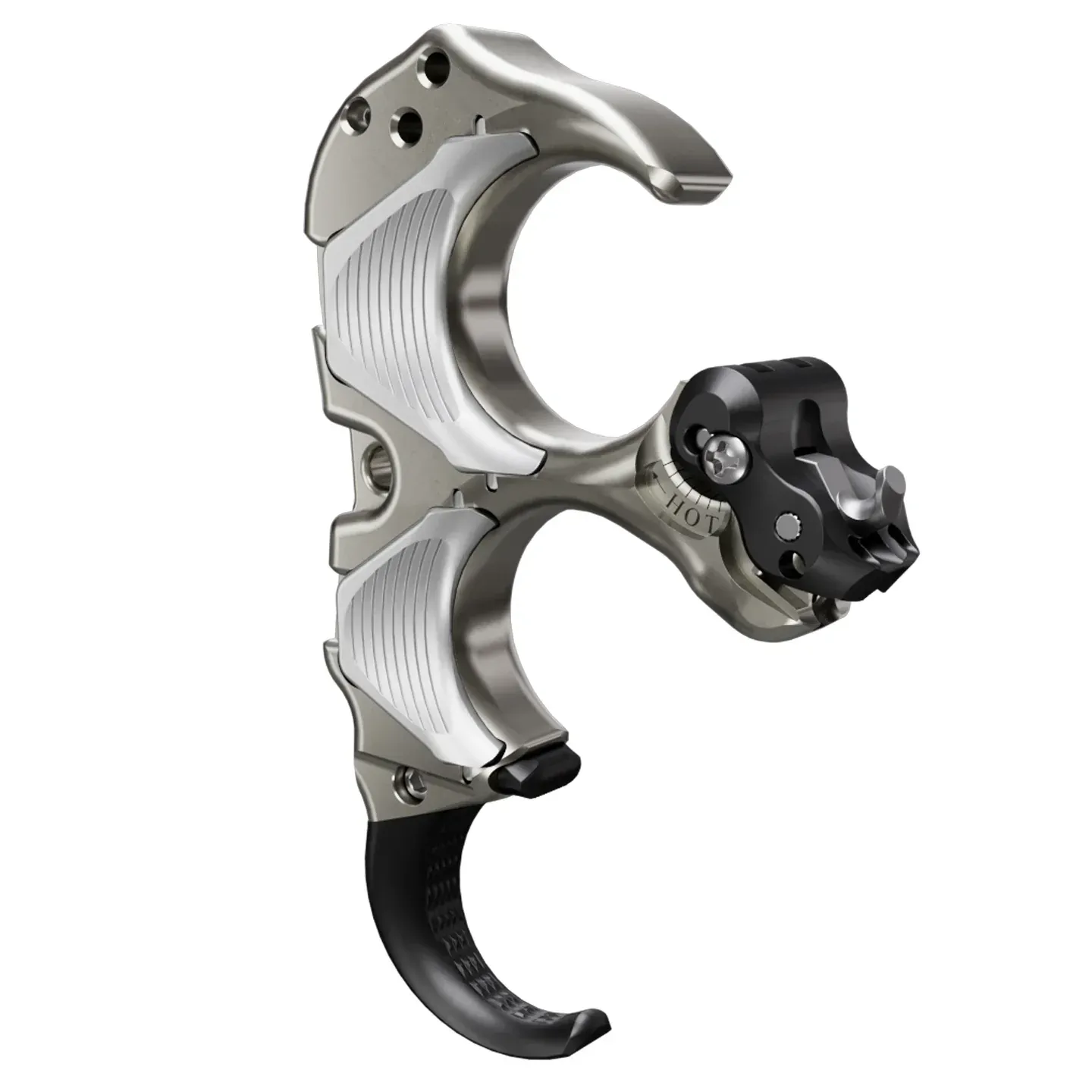
Truball Aileron
Truball Aileron (HBC Flex)
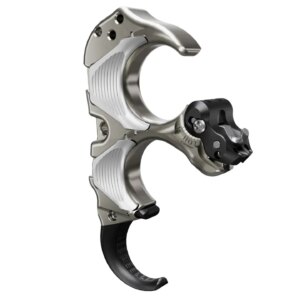
I think that’s the full name of the release, maybe the words aren’t supposed to show up in exactly that order. This is the evolution (four or five generations newer) of the release that I currently use. It has wings on the first two fingers to let you align it in your hand. It’s not new for the show and I don’t know if I really need this, but I keep stopping by their booth to check it out just in case.
I think the only thing it doesn’t have is a micro adjust click which is somewhat common on releases these days.
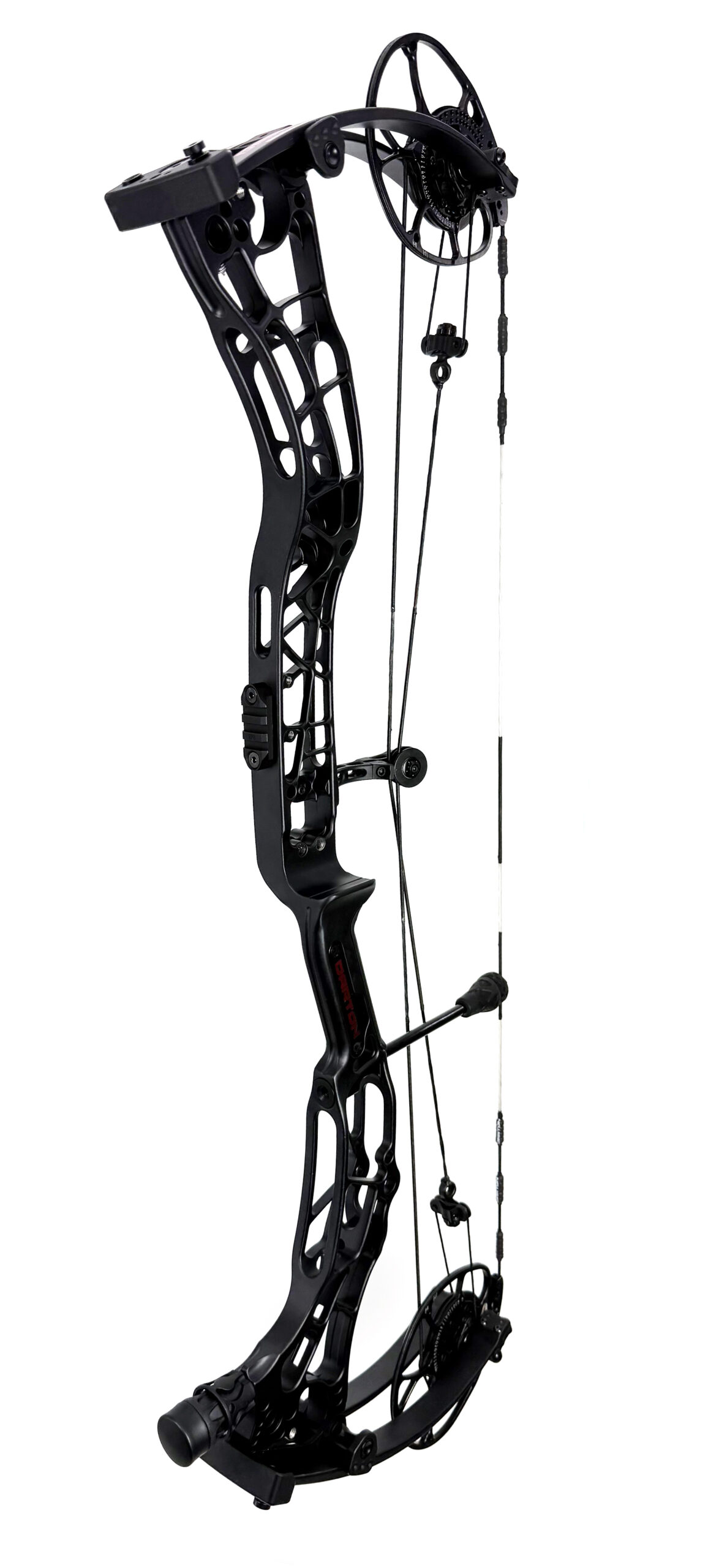
Darton Tritech 35
Darton Tritech (35)
This year’s latest from Darton and a slight evolution of last year’s Sequel ST2 which I’ve been contemplating since it came out. One more adjustment has been built into this one.
For reference, a major source of “innovation” in the last few years have been bows that can be timed and tuned with no bow press. Darton developed a system where the limb pressure can be slightly adjusted left to right to eliminate cam lean and the cables have a screw to adjust length. This year, they also added an adjustable cable guard, which is arguably less important than those other tow, but rounds out the package.
I had a brief discussion with the Darton guys (in which I did NOT ask them “What’s the point?”). I did ask about a 37-39″ version that they might consider making in the future and the answer was not “no”, so that’s good.
I’ve spent a lot of years using Bowtech’s yoke tuning system on, I think, seven bows since 2011. I have tried others’ tuning systems and never really loved them. Most recently, that included Elite’s SET system, in some ways similar to Darton’s, which I found to be insufficient. So, with this in mind, I was asking various semi-engineering questions about their limb deflections and shims. We also touched on mod choices (there will be three – a smooth, a performance and a 75% let-off), and exactly what changed since the Sequel (newer cable adjusters, addition of cable clearance adjustment). Afterward, I got to put a few arrows through a 35 (also comes in 31 and 33 inch axle to axle models) and while I normally add a lot of weight to my bow, even bare it felt pretty awesome to shoot.
Darton also added picatiny mounts for both the sight and rest. I’m guessing this is important to some people and seems to be a common thing in the industry, but I don’t think it’s really useful to me as I’d probably continue using my existing bolt-on sight and rest anyway. So, maybe this is my “What’s the point?” feature here, but it seems that everyone is doing it, so they have to do it to keep up with the industry.
Martin X Spot 40
This is a 40″ target bow that has a riser that I really like – that is, it’s a stick with cutouts. No metal goes where it doesn’t need to be. No swoops the wrong way just for style. It looks like the evolution of the 2019 Anax series of bows.
I put a few arrows through it as well and it felt quite nice. They have licensed Darton’s tuning system (it’s identical). I think it lacked the other two adjustments available on the Darton.
I don’t love the new arrow shelf as compared to the older models – it’s very rounded off above the index finger, not quite gone entirely, but barely there. To be fair, this bow is probably not for me anyway at 40″ axle-to-axle since I only have a 28″ draw.
Martin’s website seems to be pretty poor and at the time of writing this, I can’t find anything about the X Spot or as it was called in their catalog, the M40 (I think).
The thing that these two bows have in common that caught my interest is the very parallel limbs. I may be the only target archer who is willing to say that they do not want the bow to jump forward on the shot. I should be pushing it forward, yes. The bow should move forward on a good shot – and it does, because sometimes I drop it on the ground like a doofus. The bow geometry itself doesn’t need to add motion of its own.
Quick history lesson – sometime in the early 2000’s bow companies came out with parallel limb bows. Before that, compound bows looked more like recurves with long, vertical limbs. They hit the hunting bow line up first, since vibration and noise were the key improvements and that really matters more to the hunting crowd. Some companies even made limbs that went beyond parallel and sloped back toward the archer. The idea here is that when the limbs spring back on the shot they don’t spring forward, they spring outward – one up and one down – in equal and opposite directions, cancelling out any vibration, noise and momentum. The trend took longer to hit target bows, but by the late 2000’s even target bows had parallel limbs and longer risers – a side effect of the limbs not making up as much of the bow’s axle-to-axle length.
It’s been a refrain in target archery for a long time that the bow should jump forward on the shot. I know some people thing this is advantageous, but I think they’re just parroting the current trends and marketing. Target bows had parallel limbs for years. Only in the last five years or so that trend has reversed. In my opinion, it’s because they needed to change something to make the new bows different so they could claim they were better. It also means shorter risers, which means smaller billets of aluminum, which means lower cost and higher profitability.
I don’t like it. This is part of why I currently shoot a bow that is roughly 9 years old and I’ve tried to replace it three or four times to no avail.
FirstString Bow Strings
Lastly, I invaded on a discussion Paul was having with the owner of First Strings. Much like the Darton chat, there were a lot of technical engineering or engineering adjacent discussions of their unique material, twist orientations, the function of speed nocks, etc.
It was an interesting chat. I don’t use their strings because I make my own, but it did make me wonder if my homemade strings are up to par with the best. I’ve never had an issue with mine, and of course I think I’m a good string builder, but I’m sure there are some tricks that I’m not familiar with.
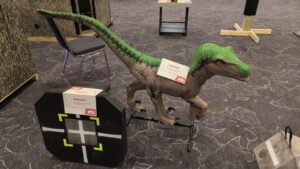
I think that’s it for the technical. Oh, and here’s a Velociraptor target from Reinhart, new for this year. 😛
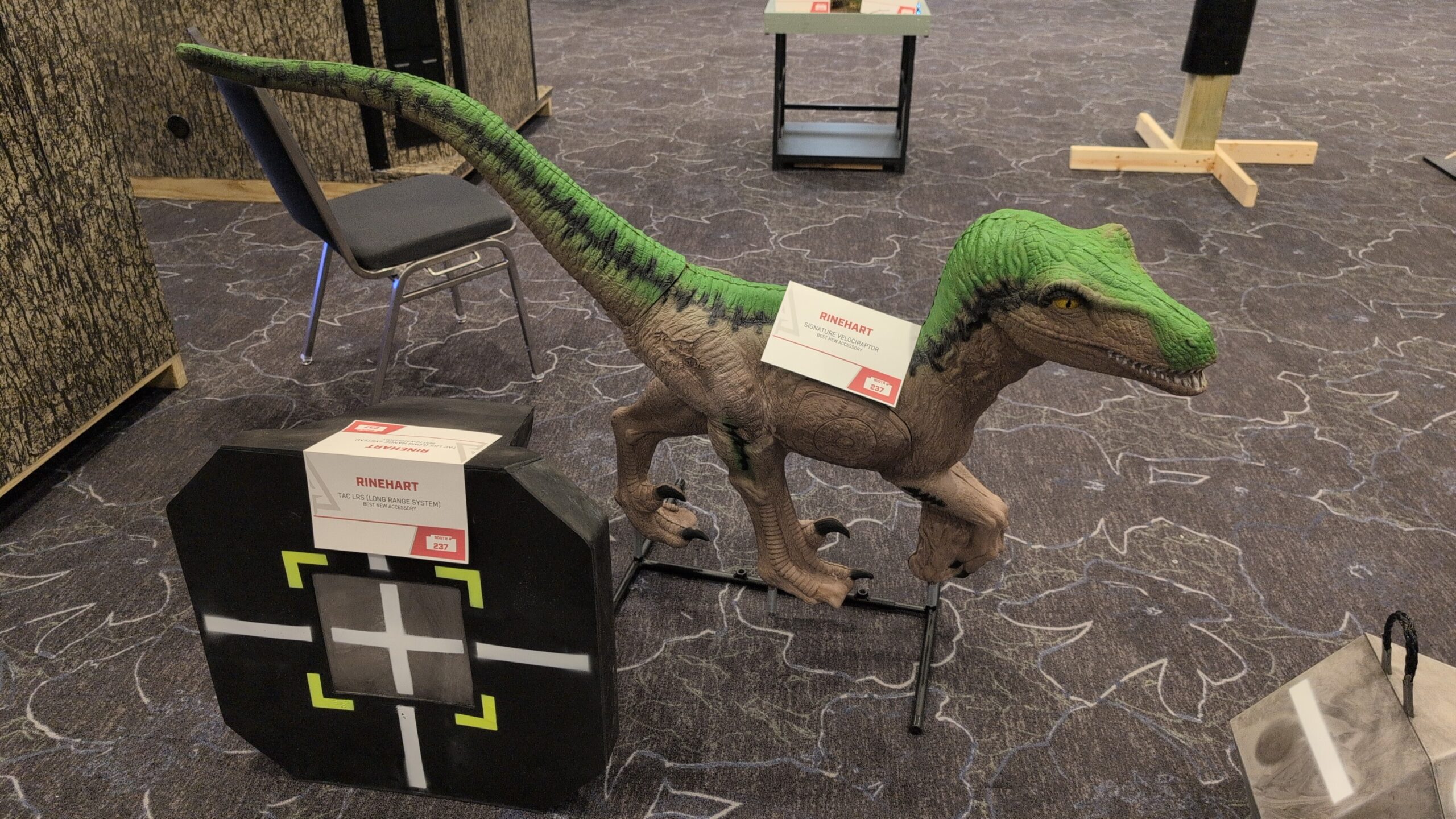
Reinhart Velociraptor
Archery Day 1
OK… back to the archery, which really, there is much less to say about.
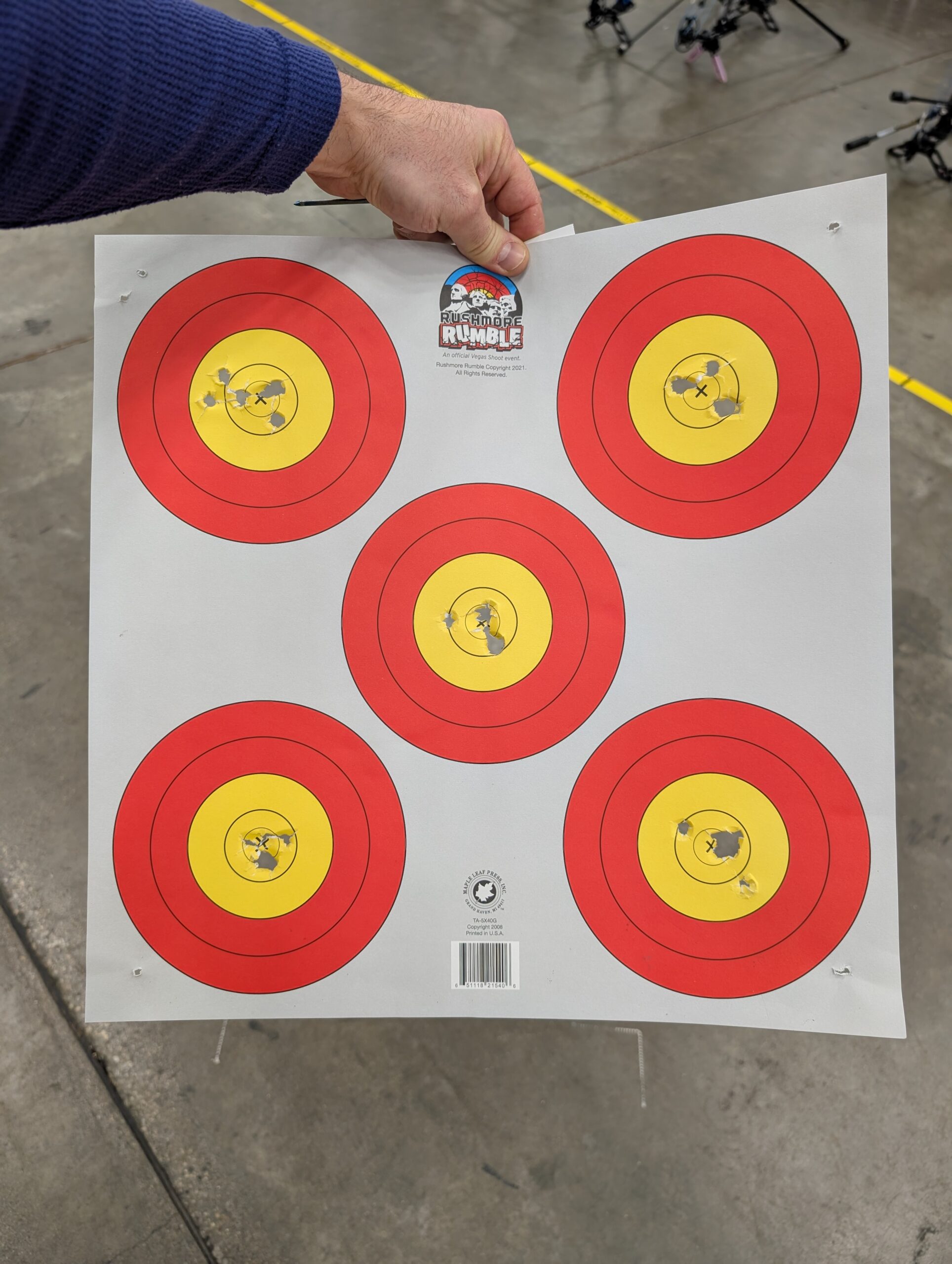
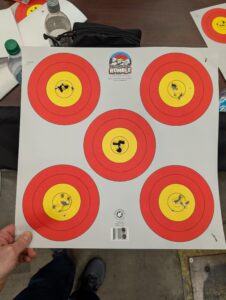
Day 1 Target 2
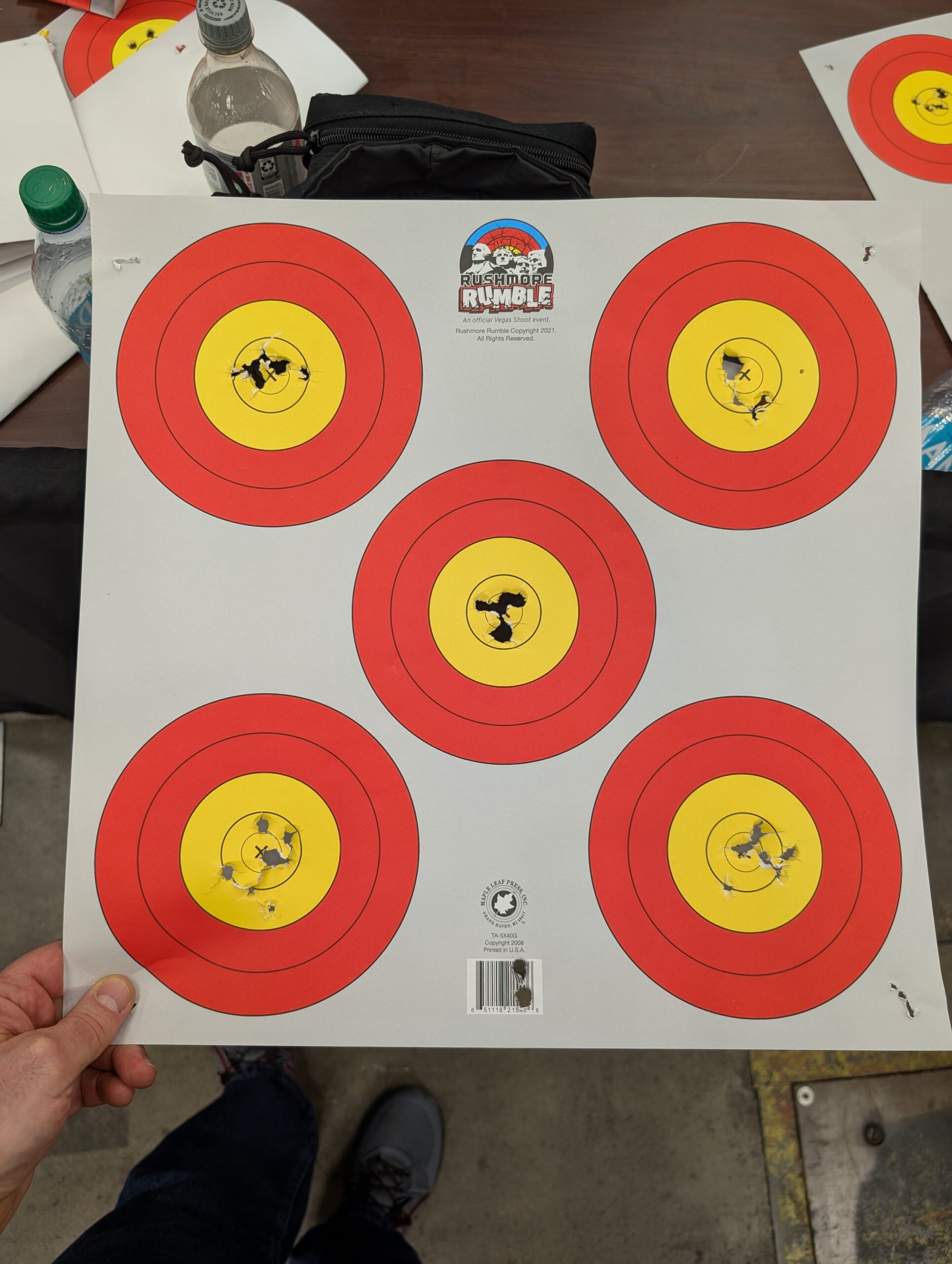
Day 1 Target 1
I went over to the practice range around 2:00, got in 30 or so arrows and then went to my bale.
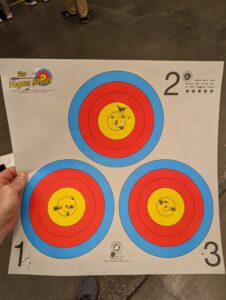
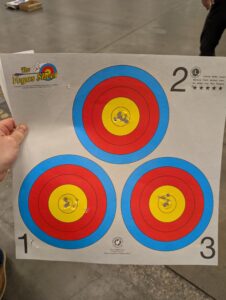
The actual event in target archery is probably the most painfully boring thing to describe in text (worse than golf). I had a clean first half (Target one does have a nine, but that was in the practice rounds). Then I dropped two in the second half, one early on and one late. I think the low hit on spot 5 was the first and the left hit on spot 1 was the second. Neither were the best shots, which really kind of violates the core principle of target archery wherein one should only execute the best shots possible and not worry about the score.
Once again, I hadn’t eaten much but bars, I was quite hungry and ended up at an Irish Pub for dinner where I got a ruben, which was labled “Indy’s best”, a claim which may have been valid, but once again it was really more food and less healthy food than I should have been looking for. This trip really was a failure of nutrition. It’s hard to go out to eat and be healthy, I need to prepare better and pack some groceries so I can reliably get something fresh and classified as a vegetable. I had a vague plan to do this on this trip, but I got a later start than expected and didn’t want to take the time to get groceries on the way down, so instead my food plan consisted of 12 energy bars and whatever I found along the way.
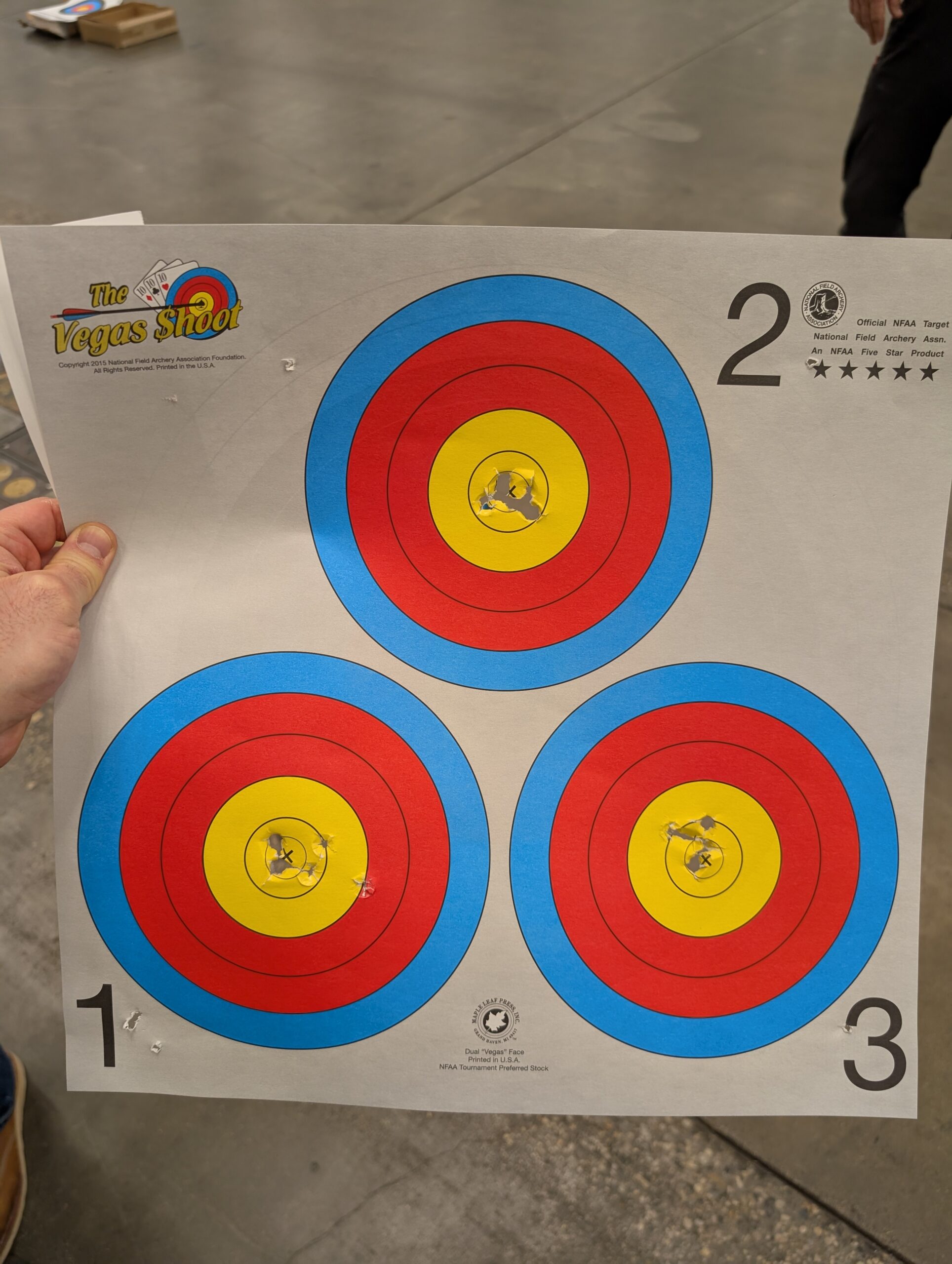
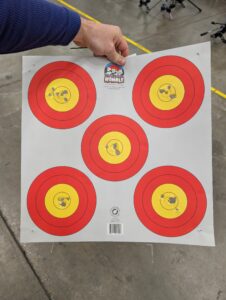
Day 2 Target 2
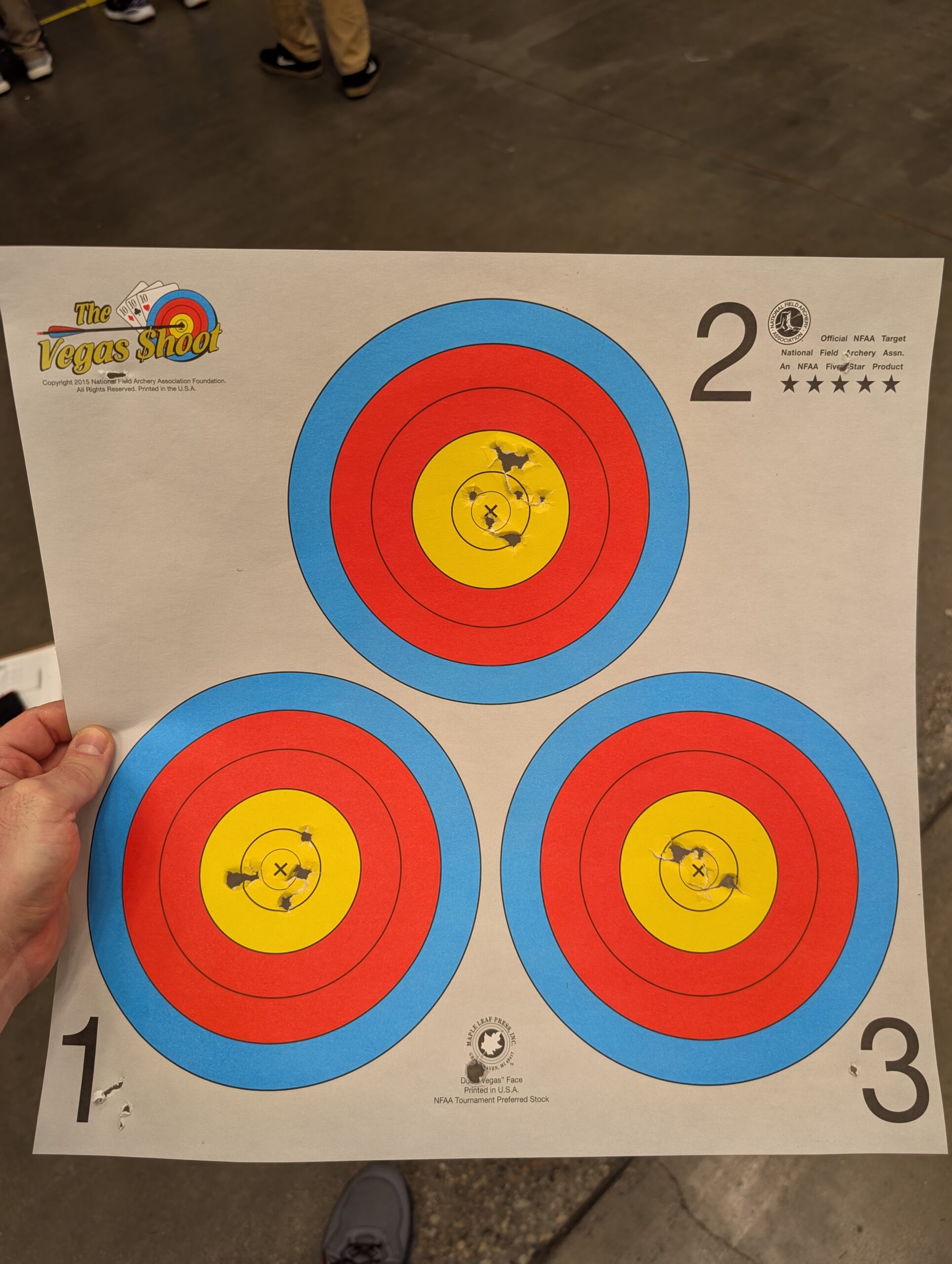
Day 2 Target 1
Archery Day 2
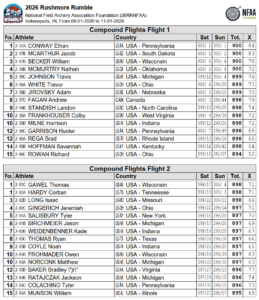
I found out I had made flight #2 (out of 19 flights with 16 people per flight). I came in somewhere around the middle of the flight – tied in score but behind in X-count.
I made it 7 ends before dropping one point in end 8. There was a super close call earlier as well, both popped high on spot #2 (which I shoot first). I think I was just tense, tired, was pulling too hard with not enough forward pressure to balance it out. On the last two ends, I modified my process slightly and they went fine. It just stinks that it takes that one reminder arrow to get there. Had I not dropped that 10, I’d have “tied” for first and ended fourth by X-count. Instead I “tied” for fourth and dropped six places by X-count. X’s are the tiebreaker here and though my scores were good, my X count was relatively low compared to others with similar point scores.
For anyone not familiar with the flight system, you are ranked after the first day and divided into groups of, in this case, 16 people. On the second day, you are competing only within your flight, which should be with those archers most closely matched to yourself. Score is cumulative across both days. The system can be gamed, shooting below your potential on day 1 and then better on day 2, but in reality, that’s tough to do without knowing the field. Example, knowing the end results for this shoot: I missed one point on day 2. In order for that day 2 difference to net me money, I would have had to drop two more points on day one could have taken second in flight #4 (worth $360) or drop six more points on day one and could have come in first in flight #5 (worth $571).
The End
So, after signing and turning in scores, it was back to bow storage to pack up and head out. I ended up getting on the road around 1 – 1:30 which put me home around 5:30 with a few brief stops for gas.
Final notes, if you want to buy any of that cool stuff I saw, you should buy it at Grand Valley Sporting Goods because they sponsor me. They’re in Allendale and have a huge amount of hunting gear, fishing gear and are doing their best to get target gear in stock. If you want to buy a nine year old bow to be just like me, you’re probably not going to find it in a shop. Maybe I’ll sell mine when I get a new Tritech 37.
Anyway, here’s all the pictures, most of which were already shown above.